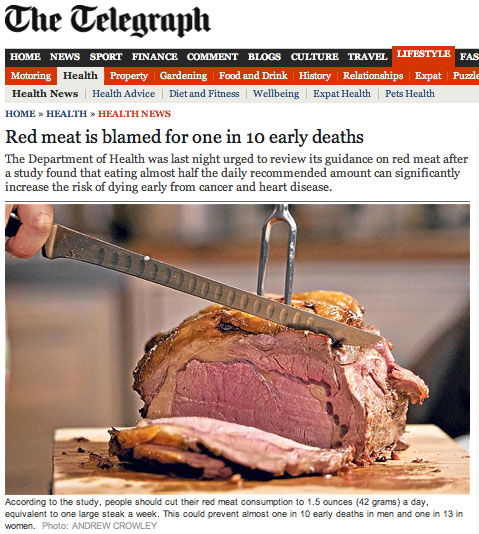
Doesn’t the photo of that beef look amazing? I just had to say that before I started. I’d love a slice of that.
You have most probably seen this study that just came out showing that eating red meat is going to kill you, eventually. Having read the numerous alarmist articles published on the topic, I thought it is my duty to say something, since so many media outlets have started going crazy for this piece of news. Here’s the link to the article by The Telegraph.
I don’t know how this rubbish is even considered a study. What the researchers did was survey 100,000 people over a period of 28 years, asking them every 4 years about their diet and lifestyle. Asking them? So, the study wasn’t a double blind, laboratory based study? Already, I’m skeptical. Many issues are known to happen with survey studies. Namely, people lie in surveys. They do! I know I have…
OK, but putting that aside. Let’s look at this line from the Telegraph:
Small quantities of processed meat such as bacon, sausages or salami can increase the likelihood of dying early by a fifth, researchers from Harvard School of Medicine found. Eating steak increases the risk of early death by 12%.
Lisa sees through his reasoning: “That’s specious reasoning, dad.” Homer, misunderstanding the word “specious”, thanks her for the compliment.
Optimistically, she tries to explain the error in his argument: “By your logic, I could claim that this rock keeps tigers away.” Homer is confused: “Hmm; how does it work?” Lisa: “It doesn’t work; it’s just a stupid rock!” Homer: “Uh-huh.” Lisa: “… but I don’t see any tigers around, do you?”
Homer, after a moment’s thought: “Lisa, I want to buy your rock…”
Scientists added that people who eat a diet high in red meat were also likely to be generally unhealthier because they were more likely to smoke, be overweight and not exercise.
The excerpts below from Bill Bryson’s book At Home is especially interesting to me. My diet over the last year has largely been Paleolithic – pastured animal fat and protein, roots, greens and berries – with some Neolithic food thrown in, namely butter, cream, cheese and olive oil. Health-wise, I’ve never felt better. Have a read. There is such an obvious link between Neolithic food and disease and Bryson describes it so wonderfully. You’l enjoy this one.
“It is not as if farming brought a great improvement in living standards. … A typical hunter-gatherer enjoyed a more varied diet and consumed more protein and calories than settled people, and took in five times as much vitamin C as the average person today. Even in the bitterest depths of the ice ages, we now know, nomadic people ate surprisingly well – and surprisingly healthily. Settled people, by contrast, became reliant on a much smaller range of foods, which all but ensured dietary insufficiencies. The three great domesticated crops of prehistory were rice, wheat, and maize, but all had significant drawbacks as staples. As the journalist John Lanchester explains: ‘Rice inhibits the activity of Vitamin A; wheat has a chemical that impedes the action of zinc and can lead to stunted growth; maize is deficient in essential amino acids and contains phytates, which prevent the absorption of iron.’ The average height of people actually fell by almost six inches in the early days of farming in the Near East. Even on Orkney, where prehistoric life was probably as good as it could get, an analysis of 340 ancient skeletons showed that hardly any people lived beyond their twenties.
“What killed the Orcadians was not dietary deficiency but disease. People living together are vastly more likely to spread illness from household to household, and the close exposure to animals through domestication meant that flu (from pigs or fowl), smallpox and measles (from cows and sheep), and anthrax (from horses and goats, among others) could become part of the human condition, too. As far as we can tell, virtually all of the infectious diseases have become endemic only since people took to living together. Settling down also brought a huge increase in ‘human commensals’ – mice, rats, and other creatures that live with and off us – and these all to often acted as disease vectors.
“So sedentism meant poorer diets, more illness, lots of toothache and gum disease, and earlier deaths. What is truly extraordinary is that these are all still factors in our lives today. Out of the thirty thousand types of edible plants thought to exist on Earth, just eleven – corn, rice, wheat, potatoes, cassava, sorghum, millet, beans, barley, rye, and oats – account for 93 percent of all that humans eat, and every one of them was first cultivated by our Neolithic ancestors. Exactly the same is true of husbandry. The animals we raise for food today are eaten not because they are notably delectable or nutritious or a pleasure to be around, but because they were the ones first domesticated in the Stone Age.
“We are, in the most fundamental way, Stone Age people ourselves. From a dietary point of view, the Neolithic period is still with us. We may sprinkle our dishes with bay leaves and chopped fennel, but underneath it all is Stone Age food. And when we get sick, it is Stone Age diseases we suffer.”
follow: